
New Customers Get 10% Off – Use Code: LUX10

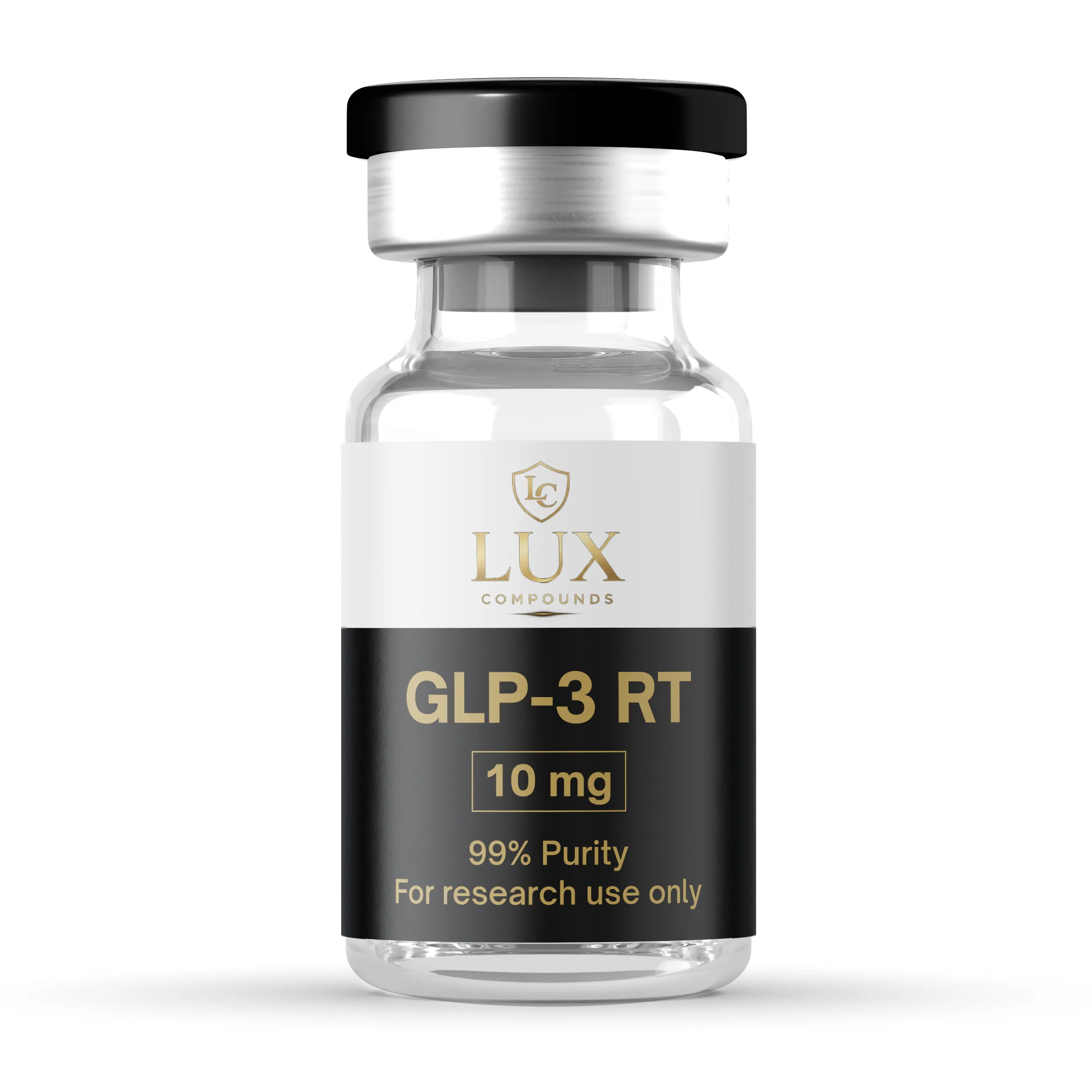
GLP-3 (RT)

5.0 Reviews

BlendsGLP-3Research chemicals

A multi-receptor peptide agonist studied in preclinical models for its interaction with GLP-1, GIP, and glucagon receptor pathways. For laboratory research use only.

All products currently listed on this site are for research purposes only.

Price range: $71.99 through $149.99

2 Day FAST Shipping

99%+ Purity Tests

Ships from USA

USA Lab Tested

We accept :

Certificate of Analysis

Third Party Tested by Freedom Diagnostics

How GLP-3 (RT) Works

The Science, Simplified

The "Triple G" Mechanism

GLP-3 (RT) is a synthetic 39-amino acid peptide that binds three distinct nutrient-stimulated hormone receptors: GLP-1 (Glucagon-like peptide-1), GIP (Glucose-dependent insulinotropic polypeptide), and GCGR (Glucagon receptor).
Key insight: Most characterized analogs engage one or two of these receptors. By additionally engaging the Glucagon receptor (GCGR), GLP-3 (RT) is studied as a model compound for simultaneous activation across all three nutrient-stimulated receptor pathways in preclinical research settings.

Lipid-Metabolism & Hepatic Pathways (Research Models)

The glucagon-receptor component is a distinguishing feature of this compound, associated in research models with signaling along lipid-metabolism pathways.

Key insight: In research models, simultaneous engagement of all three receptors is studied for its observed influence on hepatic lipid pathways. This makes the peptide a subject of interest in laboratory studies of MASH (Metabolic dysfunction-associated steatohepatitis) models.

Glycemic & Satiety Signaling Pathways (Research Models)

In research models, GLP-3 (RT) is observed to modulate gastric-emptying and insulin-signaling pathways, a profile studied alongside dual-receptor agonists.

Key insight: In research models, the compound is studied for its observed effect on glucose-regulation pathways. Its concurrent engagement of satiety-signaling receptors makes it a subject of interest in laboratory investigations of nutrient-response mechanisms.

Research Handling Notes

What research literature describes

GLP-3 (RT) is an investigational research peptide; its triple-receptor potency warrants careful handling in a laboratory setting.

🧿 Handling & Storage Notes

43%

Store lyophilized at -20°C

mild

20.9%

Reconstitute with bacteriostatic water

mild

33%

Protect from light exposure

mild

Structural & Stability Notes

Non-Suppressive Elevation

Compound Information

Technical specifications for this 39aa triple agonist

🔬 Molecular Profile

What Is Retatrutide?

Full Name

GLP-3 (RT) / Retatrutide

CAS Number

2381089-83-2

Molecular Weight

4,731.33 g/mol

Structure

39-Amino Acid Peptide

Purity

≥99%

🧊 Storage Requirements

Stability Information

Lyophilized (powder)

-20°C

24+ months

Reconstituted

2-8°C

~30 days

Handling

Avoid light and heat;

do not shake after adding solvent.

📋Research Status

Development History

Development Stage

Phase III (TRIUMPH Program)

Classification

Triple Incretin Agonist

Research Focus

Metabolic, Hepatic & Glycemic Pathway Models

US Status

Investigational Research Compound

Frequently Asked Questions

Common questions about GLP-3 (RT)

Semaglutide binds one receptor (GLP-1), and Tirzepatide binds two (GLP-1 + GIP). GLP-3 (RT) binds three (GLP-1 + GIP + Glucagon). This additional glucagon-receptor engagement is what distinguishes it as a research target from earlier single- and dual-agonist molecules.
Different vial sizes let laboratories select the total peptide quantity that suits a given research plan. Smaller vials suit preliminary characterization work, while larger vials suit studies requiring more material. Vial size reflects the amount of lyophilized compound supplied, not any usage instruction.
Dysesthesia is a term noted in the research literature in connection with glucagon-receptor activity. Investigators describe it as a possible effect of the glucagon receptor interacting with sensory pathways, and it is studied as part of the compound's receptor-signaling profile in research models.
In research models, GLP-3 (RT) is studied for its observed influence on hepatic lipid pathways. This makes it a subject of interest in laboratory investigations of liver-lipid metabolism.
GLP-3 (RT) is an investigational compound. It is sold strictly as a research chemical for laboratory research use only and is not for human or animal use.

Sources & References

Peer-reviewed research

For laboratory research use only; not for human or animal use. This product is sold exclusively for research and educational purposes. It is not intended to diagnose, treat, cure, or prevent any disease.

All research findings referenced on this page are sourced from peer-reviewed journals and official publications. They are provided for educational reference only and should not be interpreted as medical advice or product claims.

By purchasing this product, you confirm that you are a qualified researcher and will use it for laboratory research use only, in accordance with all applicable laws and regulations.